How We Made Napier Grass Silage in a 47-Liter Drum
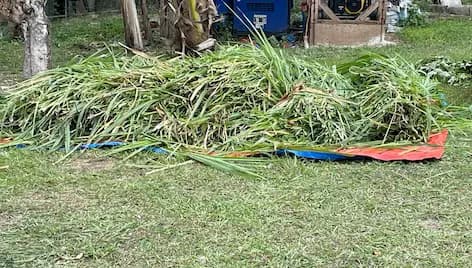
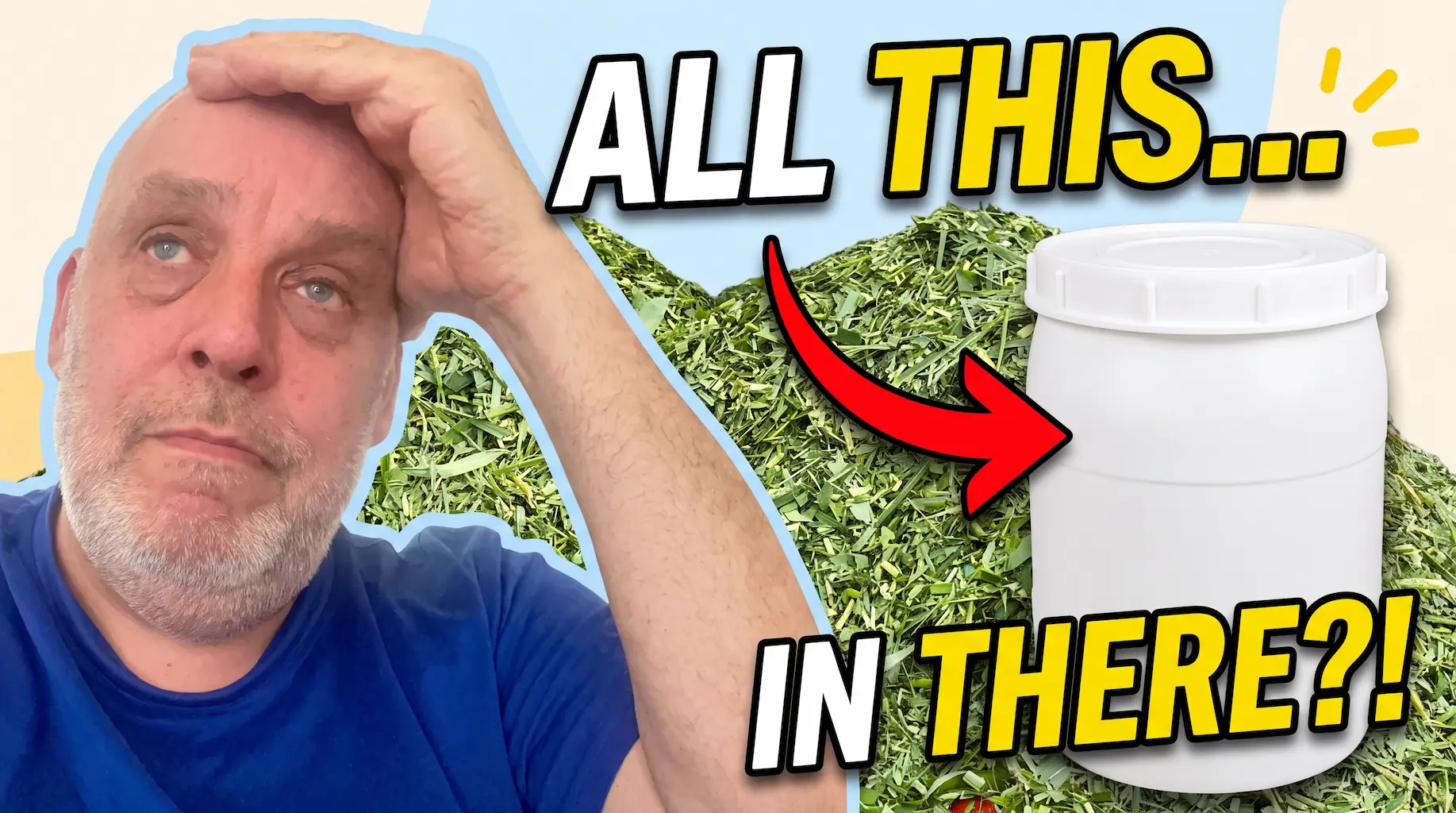
How could such a huge pile of chopped Napier possibly fit into one small 47-liter drum?
Standing on the tarpaulins at De Klomp Homestead, looking from the mound of grass to the empty drums beside it, we honestly were not sure. The answer surprised us.
This is how we packed that harvest into silage for our goats — and why the amount we fitted into each drum still surprises us.
Why we made Napier silage
Napier already belongs in the way we feed our goats from our own land. We are growing a feeding forest so more of their forage can come from plants we raise ourselves. On this day we had more fresh grass than we could use at once, and silage felt like a practical way to store it.
We were not chasing a finished feeding system. We simply wanted to learn the work carefully, one drum at a time.
Harvesting and chopping the Napier
We spread the freshly harvested Napier across tarpaulins. That gave us room to move and kept the grass off the bare ground while we prepared it.
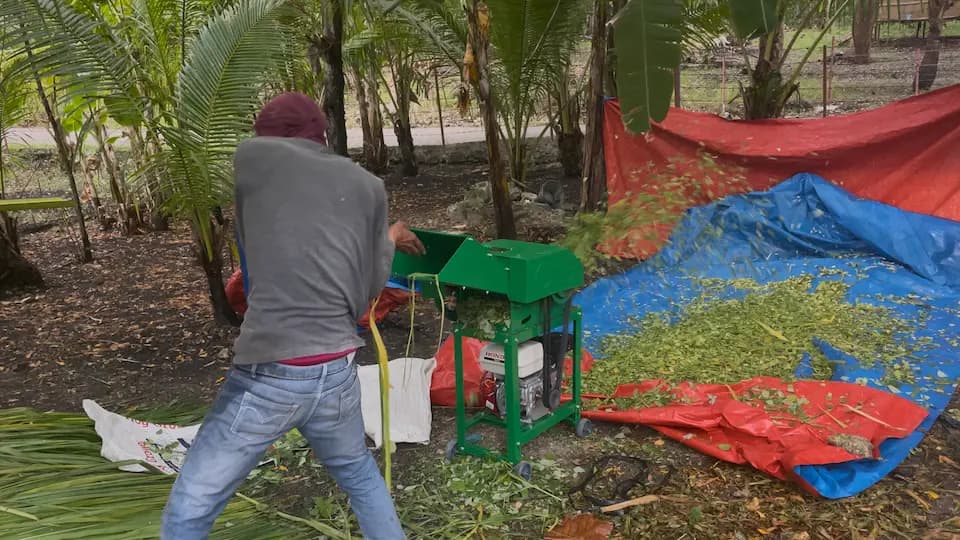
At roughly 2 inches / 5 centimeters long, the chopped pieces settled into the drum much more easily than full stalks would have. That alone does not make silage, but it made the packing ahead of us far more realistic.
Preparing the diluted molasses
While the chopper worked, we mixed the molasses.
1.5 liters of black molasses with 6 liters of water.
We used about 1.5 liters of that diluted mixture per 47-liter drum. Diluting it made it easier to trickle a little between layers instead of dumping a heavy stream into one spot. Those amounts are what we used for this batch — not a formula we would hand to every farm as the one correct recipe.
Filling the drum layer by layer
The drums were repurposed chlorine drums that had been thoroughly cleaned. Each held 47 liters.
We did not tip the whole pile in at once. A layer of chopped grass went in. A little molasses followed. Then we packed. Then another layer. We found that rhythm worked better than forcing a full drum in one go.
JM compacting the grass
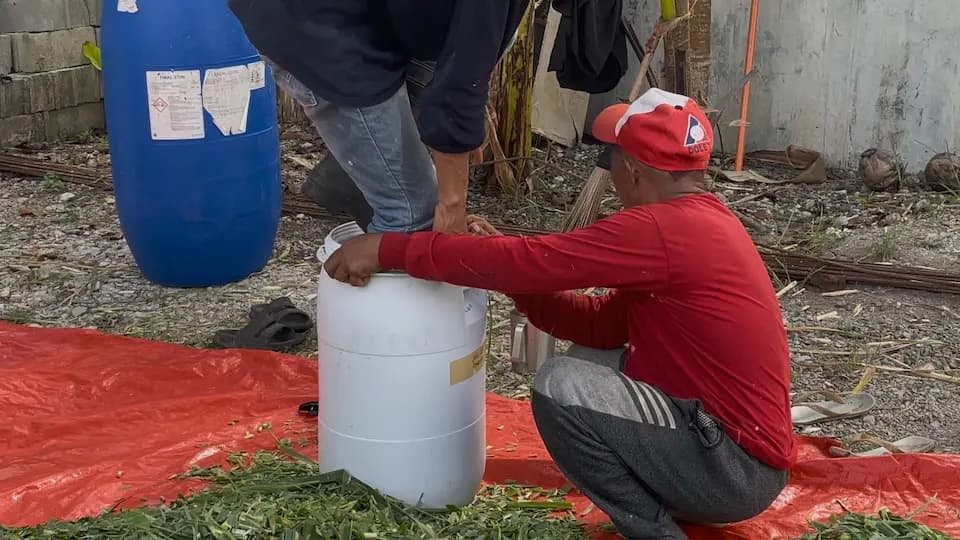
After each layer, JM climbed into the drum and compacted the grass firmly with his feet. He wore clean shoes reserved for this work. Mike’s father-in-law held the drum steady while JM pressed around the edges and through the center.
That was the heart of the day. Every time JM climbed out, the drum looked full. Every time we thought it could not take another armful. Then somehow there was room for more. The pile on the tarpaulin slowly shrank while the drum somehow kept swallowing grass.
Looking back, tight compaction — getting as much trapped air out as we could — mattered more than almost anything else we did that afternoon.
Knowing when the drum was full
Near the end a mound still sat above the opening, and JM kept pressing it down. We treated the drum as fully packed when the grass began springing back after he stepped out. That spring told us the drum would not take much more without fighting the lid.
Later we estimated that each packed 47-liter drum held about 30 kg of chopped Napier. Standing there with the empty tarpaulin beside a closed drum, that number still felt slightly unbelievable.
Cleaning the rim and closing the lid
Before we closed anything, we laid a sheet of black plastic over the opening beneath the lid and cleaned the threaded rim carefully so stray grass would not block the thread.
Two people were needed for the next part. The compressed grass pushed upward hard enough that one pair of hands was not enough. Once the lid caught the thread, we screwed it down firmly and trimmed away the excess plastic.
An improvised extra seal
We were unsure whether the old lid and rubber seal were airtight enough on their own. As an improvised extra precaution — not as a universally proven silage method — we wrapped packaging tape repeatedly around the full drum-to-lid connection.
The tape began below the lid, overlapped on each pass, and continued over the top edge. We simply wanted a little more protection on a joint we did not fully trust yet.
Labelling and waiting four weeks
Each drum was labelled with its production date and contents. Then we stepped back.
Our fermentation time for this batch is four weeks. Until then the drums stay sealed. We are not claiming success from a closed lid. That judgment comes later, when we open one.
Watch the pile meet the drum
Photographs catch pieces of the work. The video shows the thing that still makes us stop and look again: how large the pile was, how often JM climbed back in, and how roughly 30 kg of chopped Napier ended up inside one small drum.
The soundtrack uses our original De Klomp instrumental track Morning Mist on the Napier, from the Sunrise at de Klomp album.
What stayed with us
By the end of the day the lessons were already in our hands more than in a list: the shorter pieces were easier for us to pack, the diluted molasses was easier to spread between layers, and the real work was the slow, stubborn compacting that left less room for air.
This sits alongside the wider effort of feeding goats from our own land. Silage does not replace fresh forage or the longer project of a feeding forest. It is one more skill we are learning at De Klomp, the ordinary way — by doing it.
Now we wait
The drums are packed, labelled, and closed.
About 30 kg of chopped Napier in each 47-liter drum. Four weeks ahead of us. No invented result, and no premature victory.
When we open one, we will look, smell, and judge it honestly — good or bad — and share whatever we find. That is how we want to document this homestead: show the work, wait for the result, and tell the truth about what happened.
Enjoyed this story?
If you know someone who enjoys homesteading, goats, traditional food, or self-sufficiency, feel free to share it.
Related stories from De Klomp
More from the homestead about food, goats, growing, and building a resilient life.
Why We Are Growing a Feeding Forest for Our Goats
We are growing a feeding forest in Santander, Cebu, to provide our goats with fresh, local and renewable fodder from our own land.
Read the story →
Indigofera Found: One More Piece of the Feeding Forest
We found Indigofera growing at De Klomp and began exploring how this high-protein tropical forage could support our goats and feeding forest.
Read the story →
Why a Homestead Isn't the Same as a Farm Business
De Klomp is a home first, not a conventional farm business. We grow food, build practical skills, reduce dependence, and sell only when surplus makes sense.
Read the story →
Why Every Homestead Needs Music
Music motivates our work, softens our rest, and shapes the energy of daily life at De Klomp — and it led us to release our first album from the homestead.
Read the story →More stories from the homestead
More honest lessons from goats, gardens, bread, and daily life on the land.